




-
Water stays liquid below freezing until disturbed.
- Below freezing, pure water waits for one trigger to crystallize.
- Pure distilled water freezes instantly when ice crystal introduced.
- Good ice makers orchestrate nucleation, cheap ones hope.
Listen to an audio explainer
One ice cube doesn't just cool your drink—it absorbs 334 joules per gram without getting warmer. This is latent heat: the hidden energy sink that keeps drinks at 0°C for hours. Understand this physics, and you'll know exactly how much ice you actually need for parties, bars, and life.

The Paradox: Why Ice Doesn't Warm Up
Ice absorbs heat without getting warmer until it melts.
Put a thermometer in melting ice. Watch it. The temperature stays locked at 32°F (0°C). Now pour hot water over that ice. The thermometer still reads 32°F. The ice is absorbing massive amounts of heat—you can see the water melting, feel the cooling—but the temperature refuses to budge.
This breaks intuition. Heat should make things warmer. But not when a phase transition is happening.
Welcome to latent heat: the energy that disappears into molecular reorganization instead of temperature change. It's the reason ice is a superhero cooling agent. Not because it's cold. But because melting ice is a energy sponge.

What Latent Heat Really Is
Latent heat: energy absorbed during phase change, not temperature change.
We learn early that adding heat makes things hotter. True for most situations. But during a phase transition (solid → liquid, liquid → gas), the temperature flatlines while heat pours in.
- Why this happens: To transform ice into liquid water, molecules must break free from their rigid crystal lattice and gain freedom to move. This reorganization requires enormous energy. Roughly 334 joules per gram (for ice → water). That's not a small number.
- The math: One ice cube (roughly 30 grams) can absorb ~10,000 joules without warming up a single degree. To put this in perspective: that same energy could raise the temperature of water by 10°C if the ice weren't melting.
- The hidden power: This energy comes directly from whatever the ice contacts—your drink. The drink loses 10,000 joules to melt that cube, so its temperature plummets. Once the ice fully melts, the latent heat "machine" shuts off. Now regular heat transfer takes over, and the now-liquid water (at 32°F) slowly warms your drink back toward room temperature.
Experiment: How to Prove Latent Heat Works
Thermometer in melting ice stays at 32°F despite heat absorption.
What you need:
- Ice cubes
- Thermometer (any kind—analog or digital)
- Glass of warm water (~100°F or 38°C)
- Timer
- Observation notebook (optional, but satisfying)
The setup:
- Prepare two scenarios: Glass A has ice cubes at room temperature. Glass B has ice cubes submerged in warm water.
- Insert thermometer into each glass. Push it into the ice, not the air above it.
- Record temperature every 30 seconds. Don't remove the thermometer—keep it in contact with the ice/water mixture.
- Observe the paradox: In Glass A (ambient air), temperature stays at 32°F for minutes while ice visibly melts. In Glass B (warm water), temperature still stays at 32°F while ice rapidly disappears. Heat is pouring in (you can see the melting), but the thermometer refuses to climb.
- The moment it changes: Only after the ice is completely gone does the thermometer start rising. Now the latent heat machine has shut off, and regular heat transfer takes over.
What you're witnessing: Pure latent heat at work. Energy is being absorbed—massive amounts—but it's going into phase change, not temperature increase. This is why ice keeps your drink cold for so long.

Ice Quantity for Parties, Bars, and Cocktails
More ice = longer drink cold time. High-output machines solve scale problems.
Most people guess at ice quantity. "I'll buy some bags from the store." Then halfway through the party, drinks are warm. Ice is gone. Regret sets in.
Here's the math nobody tells you:
- One ice cube (30g) absorbs ~10,000 joules. A typical cocktail (8 oz) needs to stay below 50°F to taste good. Room-temperature ambient air at a party is ~72°F. The temperature delta between drink and air: 22°F.
- Result: One cube cools one drink for roughly 20-30 minutes before latent heat is exhausted and regular heat exchange takes over. Then you're in a race against entropy.
- Scale this: 50 guests, 3-4 drinks each over 4 hours = 600-800 drinks minimum. If each drink needs fresh ice every 30 minutes to stay cold, you need a continuous supply. Bagged ice from the store? You'll go through 20+ pounds and still run out.
Real-World Applications: Where Latent Heat Matters Most
Latent heat powers bars, beaches, emergency coolers, outdoor events.
At cocktail bars: A high-volume bar uses latent heat to keep 50+ drinks cold simultaneously. Each drink sitting in front of a customer is melting ice, absorbing heat. The bar's ice machine must produce enough fresh ice to replace exhausted ice throughout service. One slow ice maker = bottleneck. Guests wait. Tips drop.
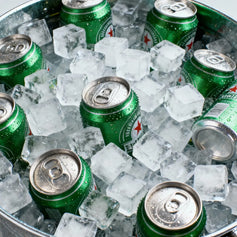
Beach coolers & picnics: A cooler filled with regular ice keeps food cold for hours because of latent heat. The ice absorbs ambient heat from the beach/air without warming up until it melts. Once melted, you've lost your cooling agent. High-output ice makers let you pre-pack multiple coolers before heading out.
Emergency and medical: Latent heat is why ice packs are standard for injuries. One ice pack absorbs thermal energy from tissue without temperature fluctuation, creating consistent cooling for recovery. Medical facilities need reliable ice supply for patient care.
Outdoor events (weddings, festivals): Large events in warm weather exploit latent heat constantly. Every cold drink, every chilled appetizer, every cooler backstage relies on ice's ability to absorb massive energy without warming. Insufficient ice = event failure. Professional event planners know this and specify commercial-grade ice machines.
FAQs
1. How much ice do I actually need for a party? Can I calculate this?
Yes. Rough formula: 1-1.5 pounds per person for a 4-hour event in warm weather.
Detailed calculation:
- One 30g ice cube absorbs ~10,000 joules over 20-30 minutes
- Average cocktail + glass needs ~2-3 cubes per drink to stay cold
- 50 guests × 4 drinks each = 200 drinks × 2.5 cubes = 500 cubes = 15 pounds minimum
- Add 25% buffer for ambient heat absorption (especially outdoors)
- Final: 18-20 pounds for typical party
2. Why does ice melt so fast at parties? Is it just the warm air?
No. Latent heat exhaustion is the real culprit—once ice melts, cooling stops.
The two-phase cooling process:
- Phase 1 (0-30 min): Ice absorbs latent heat. Drink stays at 0°C, ice melts rapidly
- Phase 2 (30+ min): No ice left. Now regular heat exchange. Drink warms toward room temperature (exponentially faster)
Why it feels like ice melts fast:
- You see the ice disappearing (Phase 1) and assume the cooler is failing
- Actually, Phase 1 is working perfectly—but it has an expiration date
- Once expired, Phase 2 takes over and drinks warm noticeably within minutes
3. Is nugget ice better than regular ice for keeping drinks cold? Does the shape matter?
Yes. Nugget ice = more surface area = faster latent heat transfer = better cooling per cube.
The surface area advantage:
- Large ice block: less surface, slower heat absorption from drink
- Nugget ice: more surface, faster heat absorption, same latent heat per gram but delivered more quickly


