






-
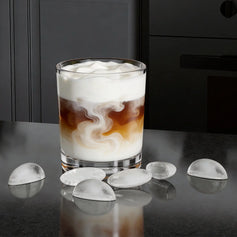
Humidity (not heat) destroys drinks fast: Water vapor condenses on cold glasses and releases heat directly into your drink, so your koozie's real job is blocking the air itself, not the sun.
- Ice simultaneously mixes, chills, and dilutes: Home ice melts in 3-4 minutes giving you only the initial flavor; bar ice lasts 10+ minutes, allowing the drink to evolve as intended.
- Clear ice melts 2-3x slower because directional freezing pushes impurities downward instead of trapping them in the core: Home freezer ice is cloudy because it freezes from all directions at once.
Listen to an audio explainer
If you place a frozen ice cube next to a bowl of leftover rice and hit start, you’ll witness a bizarre kitchen anomaly. The rice turns into molten lava. The ice? It just sits there, barely sweating, mocking your high-tech appliance.
This isn't a glitch in your microwave. It's a fundamental showdown between electromagnetic waves and molecular architecture.
How Do Microwaves Actually Work?
To understand why ice survives the microwave, we first have to bust a massive, decades-old myth.
For years, people have claimed that microwaves are magically "tuned" to the exact resonant frequency of water. In reality, this is fake news. The frequency your microwave uses (typically 2.45 GHz) was just allocated by the FCC because it was convenient for appliances. Water's actual resonant peak doesn't happen until well over 1 THz.
So, if it’s not a magic frequency, how does your microwave heat your leftover takeout?
Enter the real mechanism: Dielectric Heating.
Inside your oven, a magnetron blasts out an electromagnetic field. This field constantly flips back and forth, exerting a physical force on the molecules in your food, demanding that they align with the shifting waves.
To obey, the molecules have to rotate.
In liquid water (like the moisture in your rice), water molecules are doing the most. They are free spirits. They spin, they flip, they crash into each other. All that disordered, chaotic rotational motion and collision generates friction. Macroscopically, we feel that friction as heat.

Why Ice Won't Heat in Your Microwave?
Now, look at the ice cube.
When water freezes, its molecules stop acting like a chaotic mosh pit and lock together into a rigid, open hexagonal crystal lattice. They are bound tightly by strong intermolecular hydrogen bonds.
When the microwave blasts the ice cube and yells, "Spin!", the ice molecules are basically giving a "hard pass."
They can vibrate perfectly fine (which is why solids transmit sound waves so quickly). But because they are locked in place by their neighbors, they physically cannot rotate. They are stuck in introverted goblin mode.
No rotation = no molecular collisions = no friction = no dielectric heat.
The microwaves just swipe left and pass straight through the ice. The only reason an ice cube eventually melts in a microwave is because the air inside the oven gets warm, or the plate it’s sitting on heats up, and that warmth transfers to the ice through old-fashioned conduction.
Intuition Test
Question: Knowing what you know now, what would happen if you put a perfectly dry, massive block of clear ice on a perfectly cold, microwave-safe plate, and microwaved it for two minutes?
- A. It would explode into steam (I trust the machine)
- B. It would melt into a puddle (Obviously, it's an oven)
- C. It would remain almost entirely frozen and intact (I trust the physics)
Actually, the answer is C.
As long as there is absolutely no liquid water on the surface of the ice (which would instantly pass the molecular vibe check, heat up, and start melting the rest of the block via conduction), the microwave's radiation would ghost right through the solid ice lattice without generating heat.
Conclusion
Next time someone drops the "microwaves are tuned to water" myth, you'll know it's BS.
It's not just frozen water. It's a material with structural integrity—which is exactly why it doesn't get bullied by electromagnetic waves. Same rigidity that makes it refuse to spin in your microwave? That's what lets it preserve carbonation in your drink instead of crushing it into submission. That's what gives you that perfect crunch instead of watery mush.
Ice that won't microwave is ice that keeps its composure. And honestly? That's the kind of ice worth using.


