




-
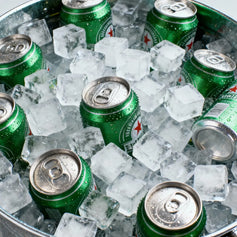
Humidity (not heat) destroys drinks fast: Water vapor condenses on cold glasses and releases heat directly into your drink, so your koozie's real job is blocking the air itself, not the sun.
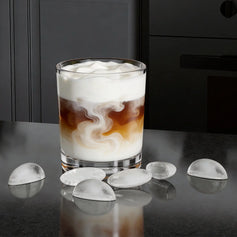
- Ice simultaneously mixes, chills, and dilutes: Home ice melts in 3-4 minutes giving you only the initial flavor; bar ice lasts 10+ minutes, allowing the drink to evolve as intended.
- Clear ice melts 2-3x slower because directional freezing pushes impurities downward instead of trapping them in the core: Home freezer ice is cloudy because it freezes from all directions at once.
Listen to an audio explainer
If you've ever stared at the cloudy, misshapen lumps spitting out of your freezer and thought, "Why is my home cocktail watered down in 3 minutes, but the bartender's lasts forever?" — this is for you.
The difference isn't technique or ingredients. It's literally what goes in the glass: ice.
Let's break down 8 cold facts that'll make you rethink frozen water forever.

1. Your Drink's Real Enemy Isn't Heat—It's Humidity
Your koozie isn't blocking the sun. It's blocking the air itself from heating your glass.
When a cold glass meets humid air, water vapor in the air condenses onto the surface. Here's the physics: that condensation process releases heat—directly into your drink. It's called latent heat of condensation, and it's the grim reaper of cold beverages.
In a humid city like New Orleans or Miami, this invisible process alone can warm a near-freezing drink by 6°F in just 5 minutes.
Your koozie works, but not for the reason you think. It's not a thermal barrier. It's a vapor barrier. It stops the air itself from executing a hostile takeover of your temperature.

2. Ice Does Three Things at Once (And Most People Get Two Wrong)
Ice isn't just cold. It mixes, chills, AND intentionally waters down your drink.
People think ice just makes things cold. Bartenders know better. Ice executes a physical trinity:
- Mix — Like the metal ball in a paint shaker, ice tumbles through liquid during a shake, creating thousands of collision points that violently integrate base spirit, citrus, and modifiers into one cohesive drink.
- Chill — Straightforward thermodynamic exchange. Ice removes heat.
- Dilute — This is the secret part. A precise amount of melted water breaks the surface tension of high-proof spirits, unlocking trapped aromas. This isn't a flaw. This is the feature. A properly diluted cocktail doesn't taste watered down—it tastes open, like the spirit is finally breathing.

3. Soft Ice Is Silently Destroying Your Soda
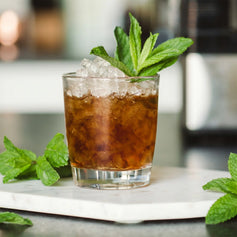
Nugget ice looks soft and friendly. It's actually a CO2 escape hatch that will flatten your soda in 15 minutes.
Here's why: Nugget ice is porous. It's covered in microscopic air pockets and rough topographical surfaces. When carbonated liquid hits these rough spots, those surfaces become "escape routes" for CO2 molecules. The bubbles see a low-energy exit and take it—immediately.
Within 15 minutes, your soda is completely flat.
This is why professional bars use nugget ice for tropical drinks (which are meant to be sweet and refreshing) but never for sodas or sparkling cocktails.

4. The Math of the Whiskey Bodyguard
A sphere has the lowest possible surface area for its volume. That's why large ice balls melt the slowest.
Here's an elegant piece of geometry: a sphere holds the minimum possible surface area for any given volume.
Less surface area = slower melting = your drink stays cold longer.
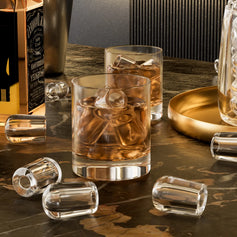
This is why a single large, clear ice sphere in an Old Fashioned keeps the spirit cold and properly diluted for 10+ minutes. During that entire window, your whiskey tastes like whiskey—not like whiskey-flavored water.

5. Why Your Home Ice Is Always Cloudy (And How to Fix It)
Your freezer chills from all directions at once. The ice ends up with white, cloudy centers full of air bubbles.
Your home freezer is fast. It's also brutal. It chills water from all directions simultaneously—a process that creates a problem.
As ice freezes from the outside in, all the dissolved gases, minerals, and impurities get pushed toward the center. The exterior is already solid, so these impurities have nowhere to go. They get trapped in the core, creating that white, cloudy, porous ice that fragments easily and melts fast.
Why this matters: Cloudy ice isn't just ugly. It's structurally weak. More surface area + more air pockets = 4-5 minute melt time instead of 10.
The three ways to fix it:
Buy it
Go to Whole Foods, your local ice supplier, or a restaurant supply store. Professional ice costs almost nothing and transforms your drink immediately.
DIY it
Use a small cooler or insulated box. Fill it with water. The trick: insulate the sides and bottom, leaving only the top exposed to freezing temperatures.
After 24 hours, ice will have frozen only from the top down. The impurities get pushed downward into the unfrozen water below. Chop off the cloudy bottom layer, and you're left with crystal-clear ice cubes. —— This is called directional freezing.
Invest long-term
A home nugget ice machine or a fridge with a built-in ice ball maker. If you host regularly or take your cocktails seriously, this pays for itself in dignity alone.

6. The Directional Freezing Flex (How to Make Crystal-Clear Ice at Home)
To make clear ice, you need to trick your freezer into freezing from only one direction.
Professional ice makers use directional freezing, but you can approximate it at home with just a cooler.
Here's the setup:
- Take a small insulated cooler or even a Styrofoam box
- Drill or cut a small hole in the bottom (for water to drain)
- Fill with distilled or purified water (tap water has too many minerals)
- Place it in your freezer with only the top exposed
- Insulate the sides with towels or newspaper
- Wait 24 hours
What happens: Ice forms only from the top downward. The air bubbles and mineral impurities can't escape upward (it's frozen), so they stay in the liquid water below.
Pro tip: Use distilled water. Tap water has dissolved minerals that create cloudiness even with directional freezing.

7. The Mpemba Effect (When Hot Water Freezes Faster Than Cold)
Sometimes boiling water freezes faster than cold water. It's rare and weird, but it happens.
Under very specific conditions, hot water can freeze before cold water. This is called the Mpemba Effect, and while it's scientifically fascinating, here's the honest part: it's not something you'll reliably reproduce at home.
It involves hydrogen bond dynamics, evaporative cooling, and specific temperature differentials. It's a genuine phenomenon, but it's also a reminder that freezing is weirder than we assume.
Why mention it? Because it reveals something important: the more you learn about ice, the more you realize how many variables are in play. Temperature is just one of them.
The Glass Diagnosis: What's Your Pour?
Now that you know the physics, let’s test your intuition.
Situation: It’s Friday night. You just poured a heavy measure of expensive bourbon and bitters for a classic Old Fashioned. What are you dropping in the glass?
A. Rapid-fire nugget ice from the fridge dispenser.
B. A handful of cloudy, half-moon crescents.
C. One massive, mathematically perfect clear cube.
The Verdict:
If you picked A or B, put the glass down. You are about to turn top-shelf bourbon into a sugary puddle in under three minutes. Cloudy crescents and nugget ice are full of micro-fissures and excessive surface area.
The correct answer is C.
A large clear rock holds the drink's spine together. With zero internal air pockets and minimum surface area, it gives you 30 minutes of slowly evolving flavor profiles without destroying the ABV.


