




-
The Paradox: Under specific conditions, boiling hot water will freeze into solid ice faster than cold water. This mind-bending glitch in the matrix is called the Mpemba Effect.
- The "Slingshot" Theory: Forget complex chemistry. Hot water molecules act like tightly pulled slingshots loaded with kinetic energy. When they hit freezing air, they snap and violently dump their heat. Cold water molecules are just relaxed, un-pulled slingshots that take the slow way down.
- The Microplastic Reality Check: Physics says a heavily scratched, beat-up plastic container will freeze hot water the fastest. But unless you want a side of microplastics with your iced coffee, don't do it. Use a textured ceramic bowl instead.
Listen to an audio explainer
Every winter, without fail, it takes over your FYP.
Someone in Minnesota or Wisconsin walks out onto their snowy driveway in sub-zero temperatures holding a massive pot of boiling water. They chuck it over their head, and instantly—boom—it turns into a majestic, glowing cloud of crystallized ice. It looks like literal magic.
But here is the question no one asks: Why don't they do it with cold water?
If you walk outside and throw a pot of cold water into the freezing air, you don't get a viral video. You just get a sad, wet driveway and a slip-and-fall hazard.
Your intuition tells you that cold water, which is already close to freezing, should turn into ice faster than boiling water. But physics is a rebel, and it absolutely loves trolling your common sense.
Under the right conditions, hot water will beat cold water in a race to 0°C. It’s a mind-bending, counterintuitive phenomenon known as the Mpemba Effect.

The 1963 Ice Cream Incident
For centuries, heavyweight thinkers like Aristotle and René Descartes suspected that hot water possessed this bizarre superpower. But it wasn't until 1963 that the scientific community actually had to confront it, thanks to a fluke accident in a home economics class.
Erasto B. Mpemba, a Tanzanian middle school student, was making ice cream. Running out of time in class, he bypassed the cooling process and shoved his near-boiling mixture of milk and sugar directly into the freezer right next to his classmates' room-temperature mixtures.
The result? Mpemba’s boiling-hot concoction froze solid first.
Initially, his teachers and classmates laughed at him. But Mpemba persisted, eventually partnering with a physics professor to publish a paper in 1969 brilliantly titled "Cool?"—giving official birth to the Mpemba Effect.
The "Slingshot Theory": How Hot Water Cheats
For decades, physicists fought over why this happens. While cold water seems to have the geographic advantage of starting closer to the finish line, hot water utilizes a few thermodynamic "cheat codes" to sprint past it:
1. The Evaporation Shortcut (Trimming the Fat)
Hot water evaporates violently. As steam rolls off the top, it extracts heat and physically reduces the total volume of liquid left in the container. Less water means less mass to freeze. Hot water literally trims down to win the race.
2. The Molecular Slingshot (The Quantum Spring)
Imagine water molecules as elastic slingshots. When you heat water up to boiling, you are physically pulling those slingshots back as far as they will go. They become incredibly tense and loaded with immense kinetic energy. When you suddenly throw those boiling molecules into a sub-zero environment, the slingshots violently snap. They release their stored energy all at once, allowing the hot water to plummet down the temperature scale exponentially faster.
Cold water? Those molecules are just relaxed, un-pulled slingshots. They have no stored energy to snap, so they just sit there, losing heat at a painfully slow, boring rate.
The Sandpaper Secret & The Microplastic PSA
Scientists recently discovered that the Mpemba Effect heavily relies on nucleation sites—microscopic scratches and imperfections where ice crystals can physically anchor and grow. In fact, if you take a piece of sandpaper and heavily scratch the inside of a container, you can virtually guarantee the hot water will freeze first, even with a massive 50°C disadvantage.
But here comes your thermodynamic reality check.
Technically, the absolute best vessel to trigger this rapid freezing is a heavily scratched, beat-up, cheap plastic Tupperware container.
Don't do this. Your survival instinct should be kicking in right about now. Pouring boiling water into a degraded, scratched plastic container and drinking the ice later is a fantastic way to consume a massive bowl of microplastic soup.
Physics doesn't care about your endocrine system, but you probably should.
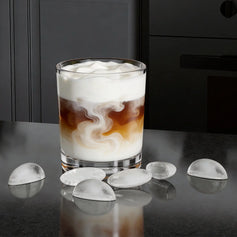
If you want to respect the laws of thermodynamics and your health, skip the cheap plastic. To get those glorious nucleation sites safely, use a high-end, heavily textured dark ceramic bowl. It provides the microscopic rough edges the hot water needs to anchor its ice crystals, without turning your iced coffee into a biohazard.
Conclusion
The Mpemba Effect is the ultimate reminder that the universe doesn't care about our linear assumptions.
It proves that the journey from a liquid to a solid isn't just a boring matter of dropping the temperature. It is a chaotic, beautiful dance of violent evaporation, snapping molecular energy, and microscopic imperfections.


